
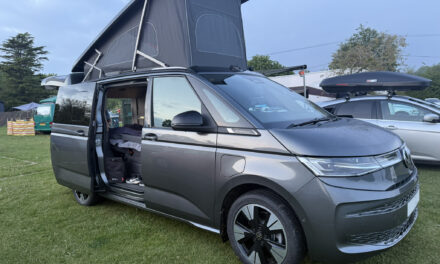
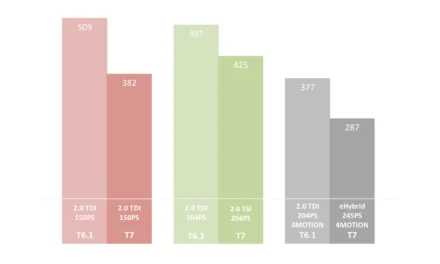
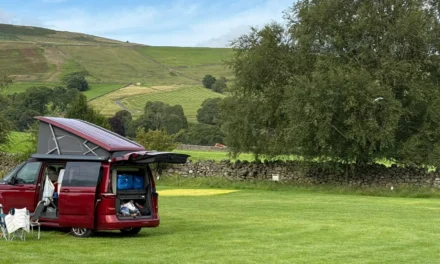





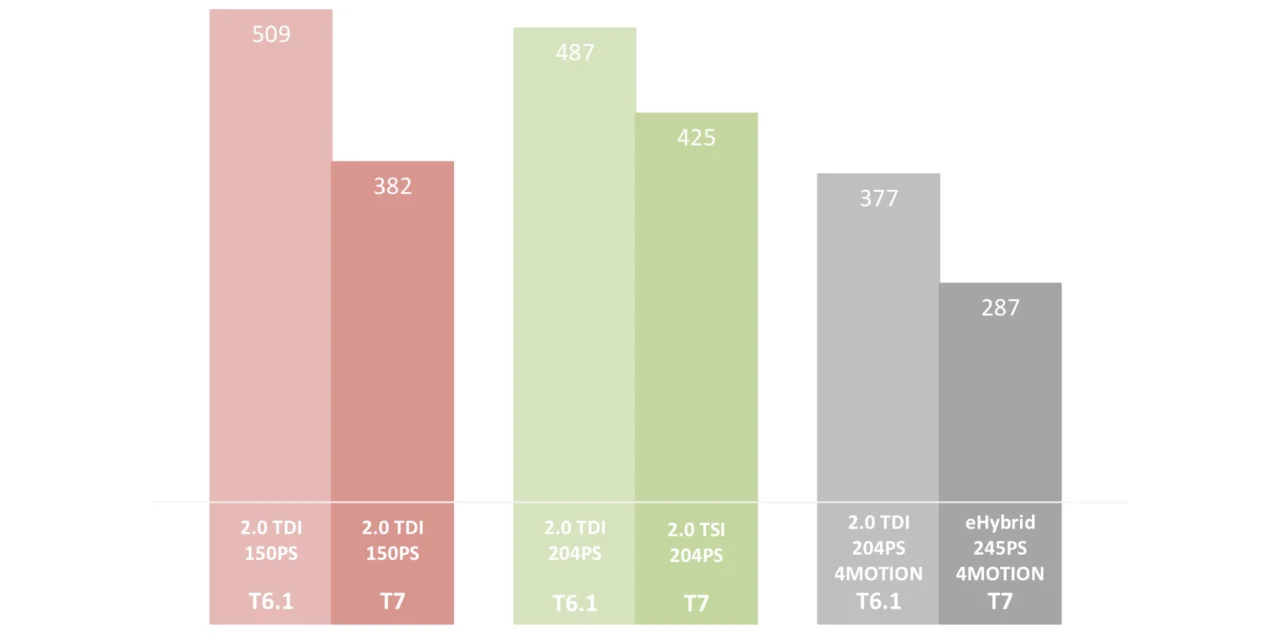
We’re looking at the Volkswagen T7 California, (245PS eHybrid 1.5 TSI 6‑Speed DSG 4MOTION) that has a Payload of 287 kg.
It’s interesting to see how payloads have changed between the T6.1 and the T7 across the different engine types.
The eHybrid, in particular, carries the additional weight of its onboard battery, and this accounts for roughly a 90 kg reduction in payload compared with the equivalent model in the previous generation.
We needed to carry out a simple analysis to understand the types of items we plan to load into the van and how they will impact the available payload.
287 kG of PAYLOAD
Just to reiterate, we have 287 kg of payload, and this already includes approximately 90% fuel and a 75 kg allowance for the driver.
To get a realistic picture, we started listing the items we expect to add to the vehicle.
People
- Overweight Driver – 40 kg (in addition to the 75kg allowance)
- Adult Passenger – 75 kg
- Girl Passenger – 20 kg
- Boy Passenger – 36kg
This totals 171 kg, meaning we have 116 kg of payload remaining for everything else.
Luggage
- Clothes
- Food
- Paddle Boards
Camping gear
- Awning
- Mattresses
- Pillows
- Sleeping Bags
- Portable Toilet
- Cooking Equipment
Water / Gas
Bike rack
- 4 x Bikes
Roof rack
- None planned yet
Accessories
Any aftermarket additions
- None planned yet
We’re now certain that we don’t have enough payload capacity to carry everything we need when travelling as a family of four.
SO WHAT KIND OF A SOLUTION DO WE NEED?
It must be easy and efficient, without detracting from the campervan experience we’re aiming for.
It needs to work whether we’re travelling as a family of three or four, depending on work commitments.
It must reduce the payload burden on the campervan itself.
Our plan is to purchase a trailer that we can use alongside the campervan. The idea is simple: the trailer will live in the garage, pre‑packed and ready to go, so we can just hitch up and head out.
To bring this to life, here’s what this means in terms of payload:
- The Volkswagen T7 California (245PS eHybrid 1.5 TSI 6‑Speed DSG 4MOTION) can tow a 750 kg unbraked trailer.
- With a UK Category B licence, you’re permitted to tow a trailer up to 3,500 kg, provided the combined vehicle and trailer weights stay within the vehicle manufacturer’s limits.
- This allows us to shift some payload into the trailer, reducing the load carried by the van itself.
Campervan
TRailer
Luggage
- Food
Water / Gas
Camping gear
- Portable Toilet
- Cooking Equipment
Luggage
- Clothes
- Paddle Boards
Bike rack
- 4 x Bikes
Camping gear
- Awning
- Mattresses
- Pillows
- Sleeping Bags
We’ve seen plenty of discussion about bike‑rack challenges on the Volkswagen T7 California. Unlike previous models, you can’t mount a rack on the rear door, so the only practical options are tow‑bar‑mounted racks or, in our case, mounting the bikes on the roof of the trailer we’re buying.
Yes, that’s right, we’re buying a trailer with a roof rack, which means we can fit a Thule bike rack on top of the trailer itself. The big advantage is that the bike weight counts towards the trailer’s payload rather than the van’s, and it doesn’t take up any space inside the trailer either.
Our general rule of thumb when deciding what goes where is simple:
- Light and bulky → Campervan
- Small and heavy → Trailer
DID YOU KNOW?
PAYLOAD & FACTORY FITTED OPTIONS
The payload will differ for each individual van e.g. More extras potentially equals less payload
FRESH WATER IS HEAVY
1 L = 1 kg If the T7 carries 25–30 L, that’s 25–30 kg gone immediately.
GAS BOTTLES ARE HEAVY TOO
A typical Campingaz 907 is ~6.5 kg full.
NOSE WEIGHT
The trailer’s nose weight transfers onto the van’s payload.
This is crucial and often overlooked.
Unbraked vs braked trailer limits
The T7 can tow:
-
750 kg unbraked
-
More if braked (likely 1,500–2,000 kg depending on spec)
Trailer MAM vs actual loading
A trailer will have Maximum Authorised Mass (MAM) from which you’ll need to deduct the Unladen Weight of the trailer to get the payload